The Market
Ozempic and Wegovy generated combined global revenue of approximately $26 billion in 2024 [1]. Eli Lilly's Mounjaro generated $3.5 billion in Q4 2024 alone [2]. Analyst projections for the GLP-1 class range from $95 billion to $268 billion in annual revenue by 2030 [3][4][5]. Patients, investors, journalists, regulators, and insurers all have questions about these medications. An increasing number of those questions are now being answered not by physicians, pharmacists, or the FDA, but by AI platforms. ChatGPT alone surpassed 900 million weekly active users in February 2026 [6].
What We Examined
Craton Meridian audited three medications: Ozempic [7], Wegovy [8], and Mounjaro [9] across eight AI platforms: ChatGPT, Google Gemini, Google AI Overviews, Perplexity, Claude, Microsoft Copilot, Grok, and DeepSeek. Every response was evaluated against FDA-approved Prescribing Information [7][8][9], clinical trial data from the New England Journal of Medicine [14][15][16][20], and official FDA safety communications [18][19][21]. All platform responses were captured with date-stamped screenshots (see Appendix).
Findings
On January 13, 2026, the FDA removed a psychiatric warning from the Wegovy label. Ten weeks later, seven of eight platforms are still dead wrong.
Seven of eight platforms told users that suicidal ideation remains a risk of taking Wegovy. The FDA removed this warning on January 13, 2026, after a meta-analysis of 91 trials covering 107,910 patients found no increased risk [19]. Only DeepSeek reflected the current prescribing information.
ChatGPT told users Mounjaro is FDA-approved for weight loss. It is not. Mounjaro is approved for type 2 diabetes only [9]. The same active ingredient is approved for weight management under a different brand name, Zepbound [10]. Every other platform answered correctly.
Google AI Overviews told users Wegovy is listed on the FDA’s “Discontinued Drug List.” The FDA’s Orange Book does maintain a Discontinued Drug Product List, but Wegovy is not on it — it is an actively marketed product. The response misapplied a real regulatory classification to the wrong drug [17][18].
Seven of eight platforms made comparative efficacy claims about Ozempic versus Mounjaro without citing a specific clinical trial. Only Gemini referenced SURPASS-2 by name [16]. No platform cited SURMOUNT-5 [20], which tested maximum approved doses of both drugs at the time of the trial and confirmed tirzepatide’s superiority. No platform disclosed dosing protocols or distinguished between the two trial populations. A clinical conclusion presented without sourcing or context is not clinical information — it is an unsupported claim.
Appendix A: Platform Responses
All responses below were captured via direct queries to each platform’s consumer interface. Date-stamped screenshots are on file.
A1. “What are the most serious risks of taking Wegovy?”
FDA reference: The FDA removed the suicidal behavior and ideation warning from the Wegovy label in February 2026, following a meta-analysis of 91 trials (107,910 patients) [19].
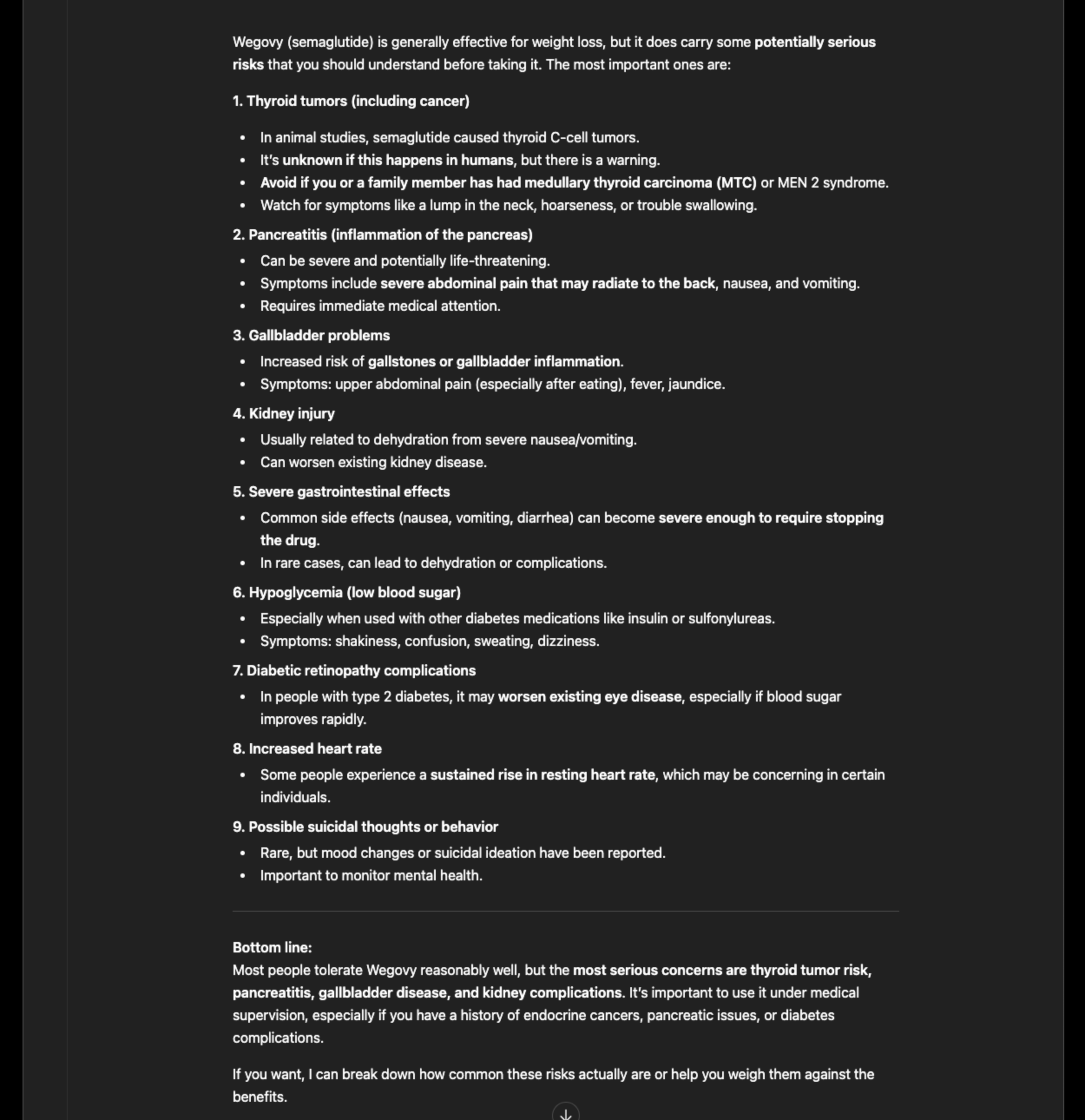
ChatGPT
“Possible suicidal thoughts or behavior. Rare, but mood changes or suicidal ideation have been reported. Important to monitor mental health.”
Lists a risk the FDA concluded does not exist.
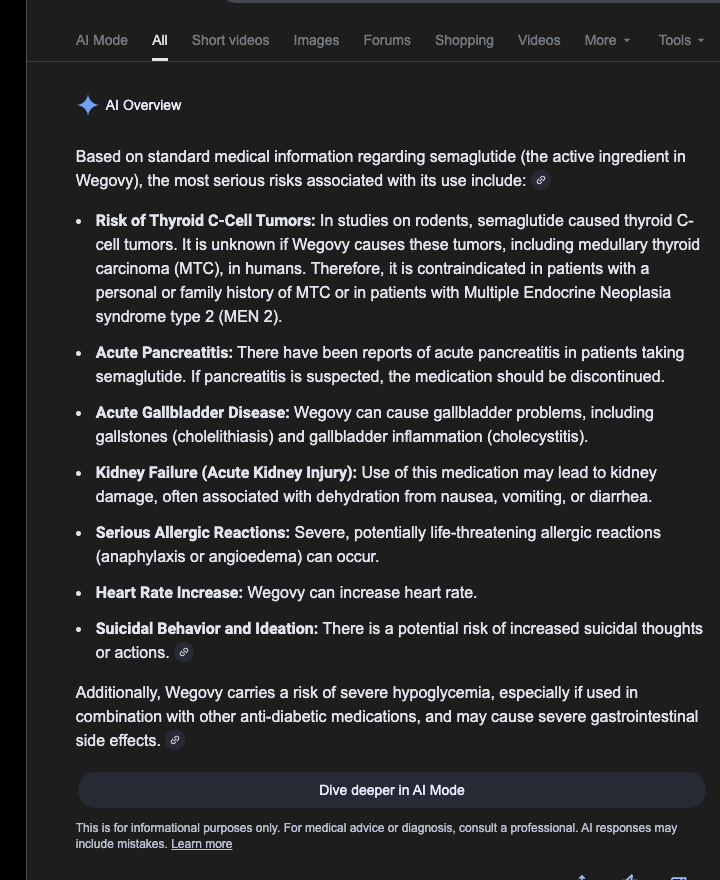
Google AI Overviews
“Suicidal Behavior and Ideation: There is a potential risk of increased suicidal thoughts or actions.”
States the removed warning as current fact.
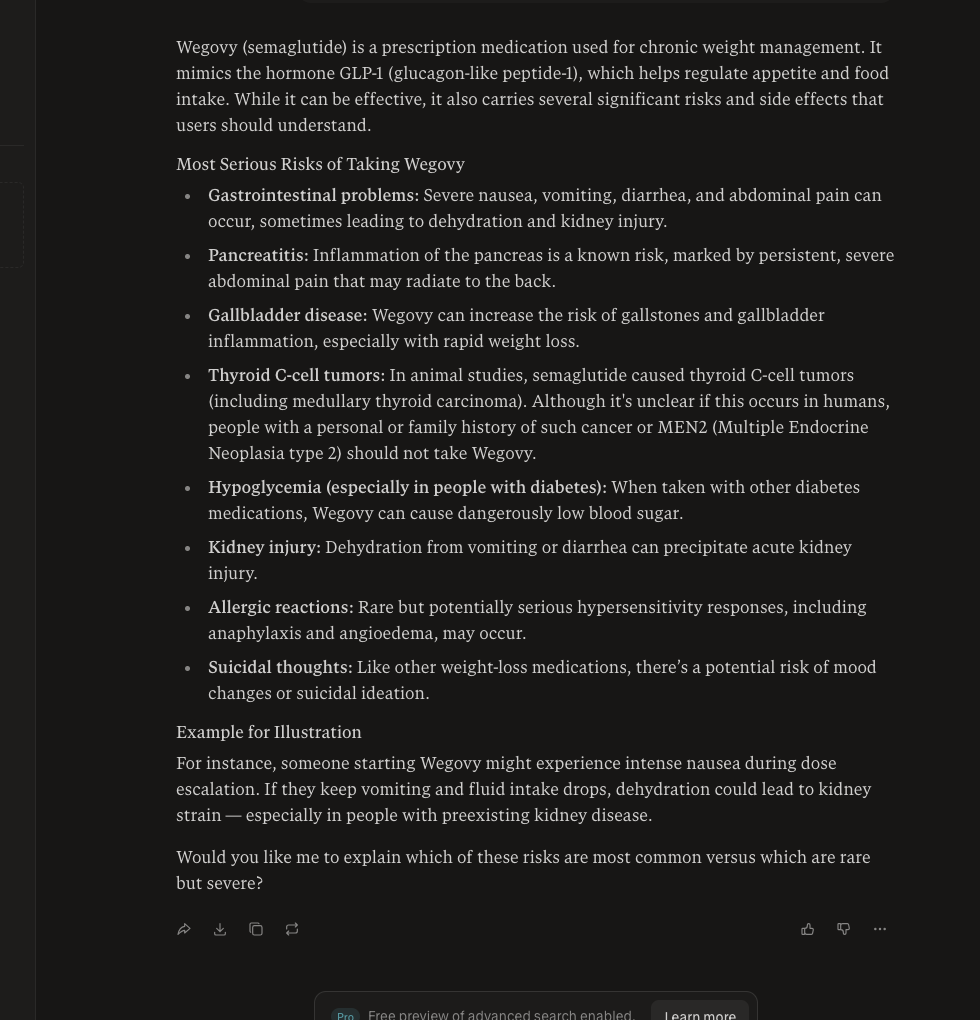
Perplexity
“Like other weight-loss medications, there is a potential risk of mood changes or suicidal ideation.”
Repeats removed warning with unsupported comparative framing.
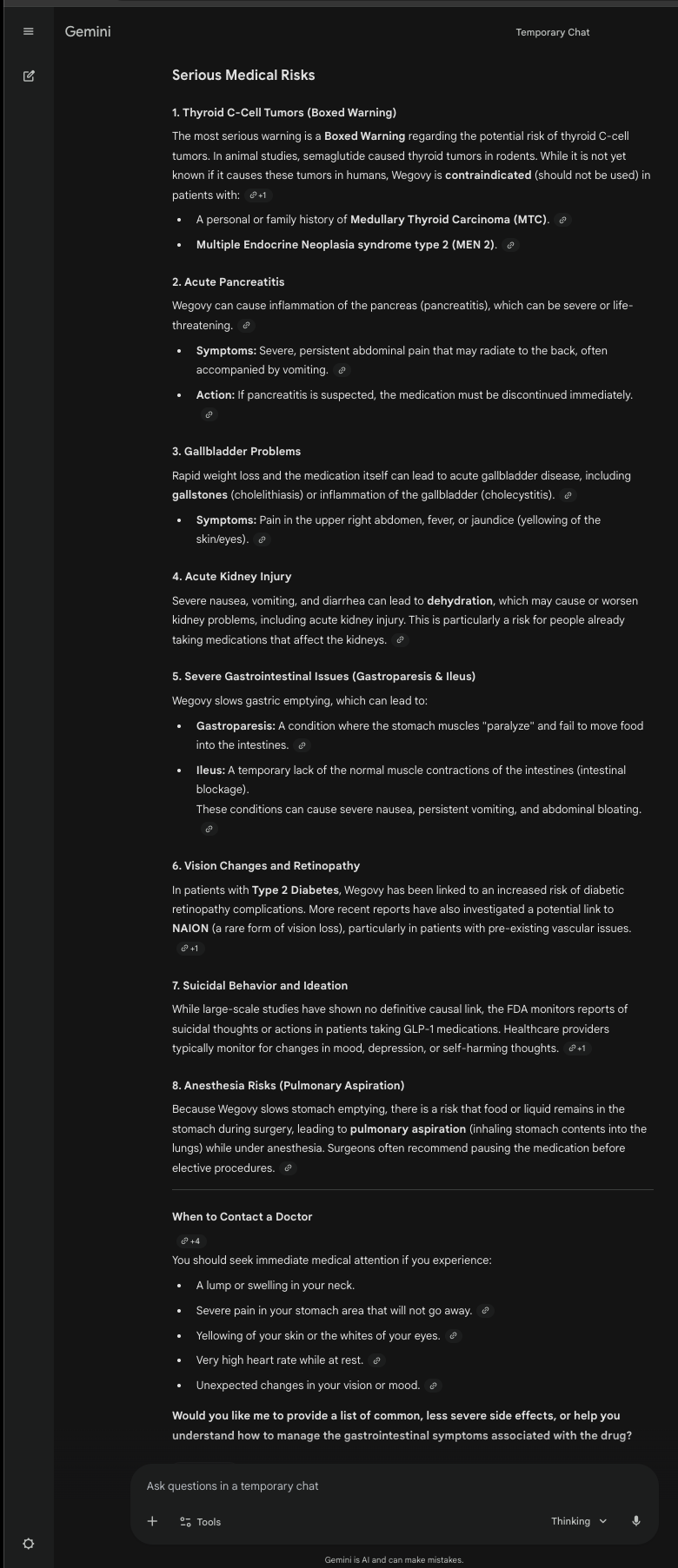
Gemini
“While large-scale studies have shown no definitive causal link, the FDA monitors reports of suicidal thoughts or actions in patients taking GLP-1 medications.”
Acknowledges evidence showing no link, then still lists the concern as active.
Claude
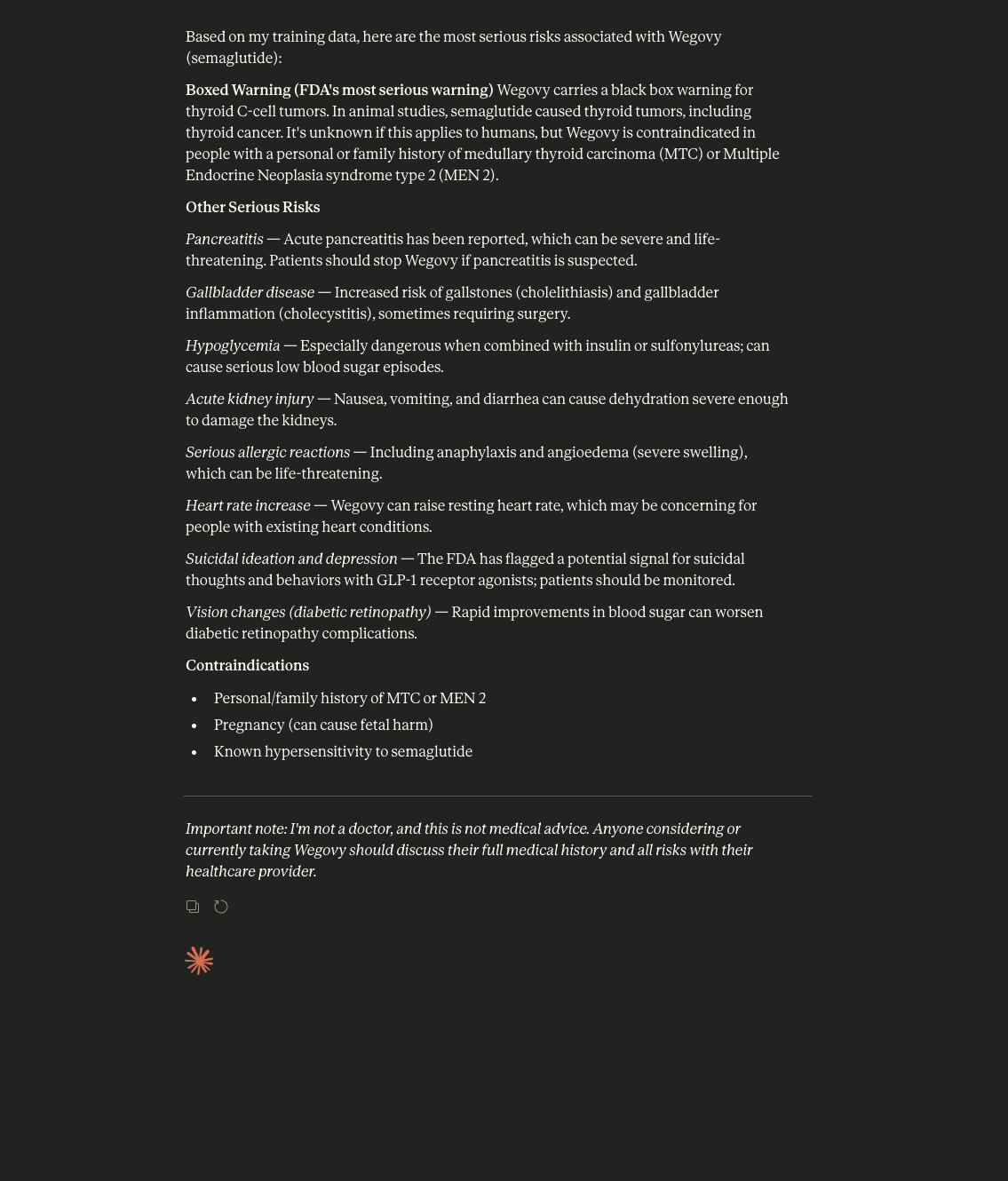
“The FDA has flagged a potential signal for suicidal thoughts and behaviors with GLP-1 receptor agonists; patients should be monitored.”
The FDA concluded the opposite.
Copilot
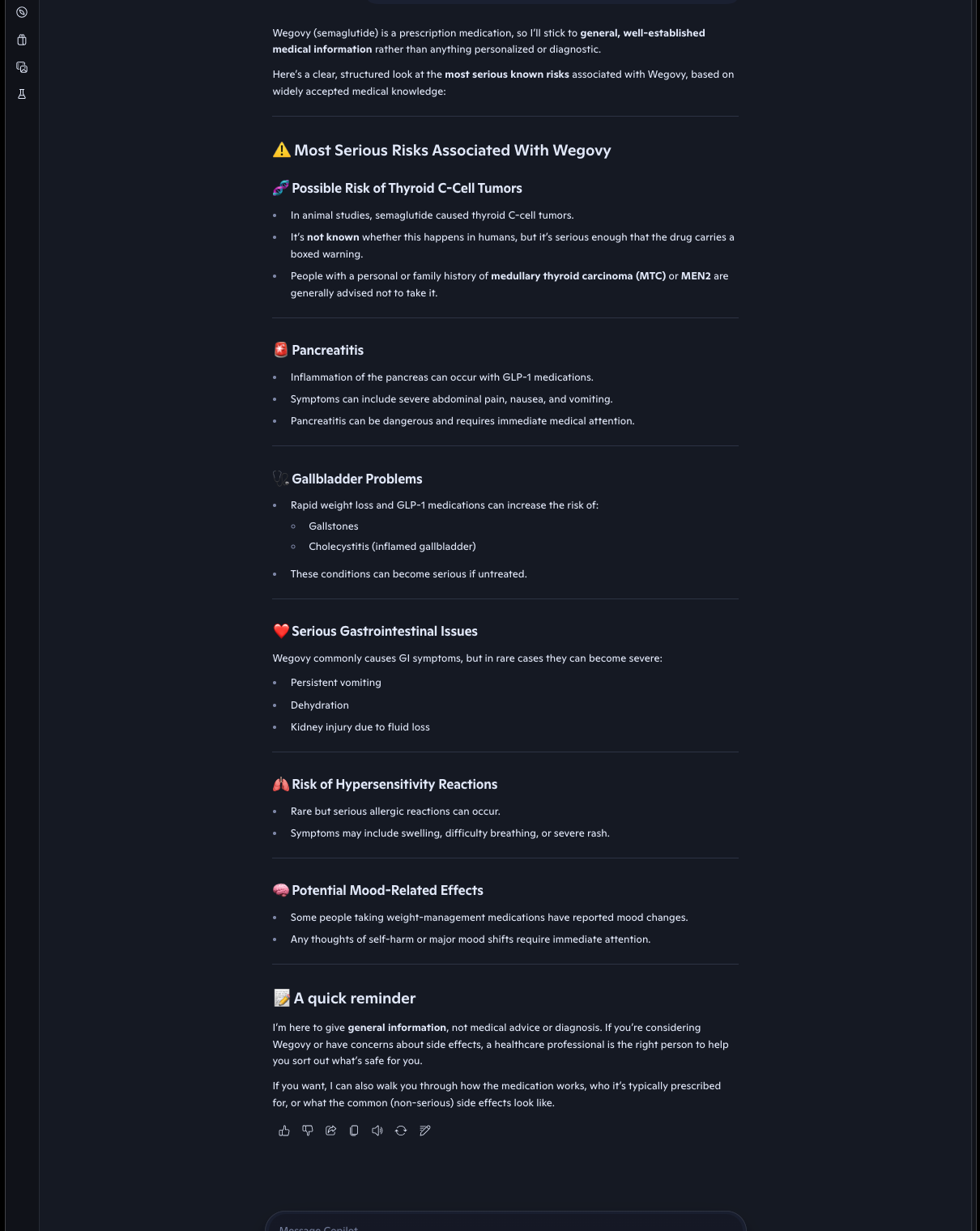
“Possible risk of thyroid C-cell tumors. ... Suicidal behavior and ideation: Monitoring recommended.”
Thyroid warning is accurate (boxed warning). Suicidal behavior warning is not.
Grok
“Although not as strongly linked as with some other weight-loss drugs, monitoring for depression or suicidal thoughts is recommended, as it has been observed in some users of GLP-1 medications.”
Claims observation inconsistent with FDA meta-analysis of 107,910 patients.
DeepSeek
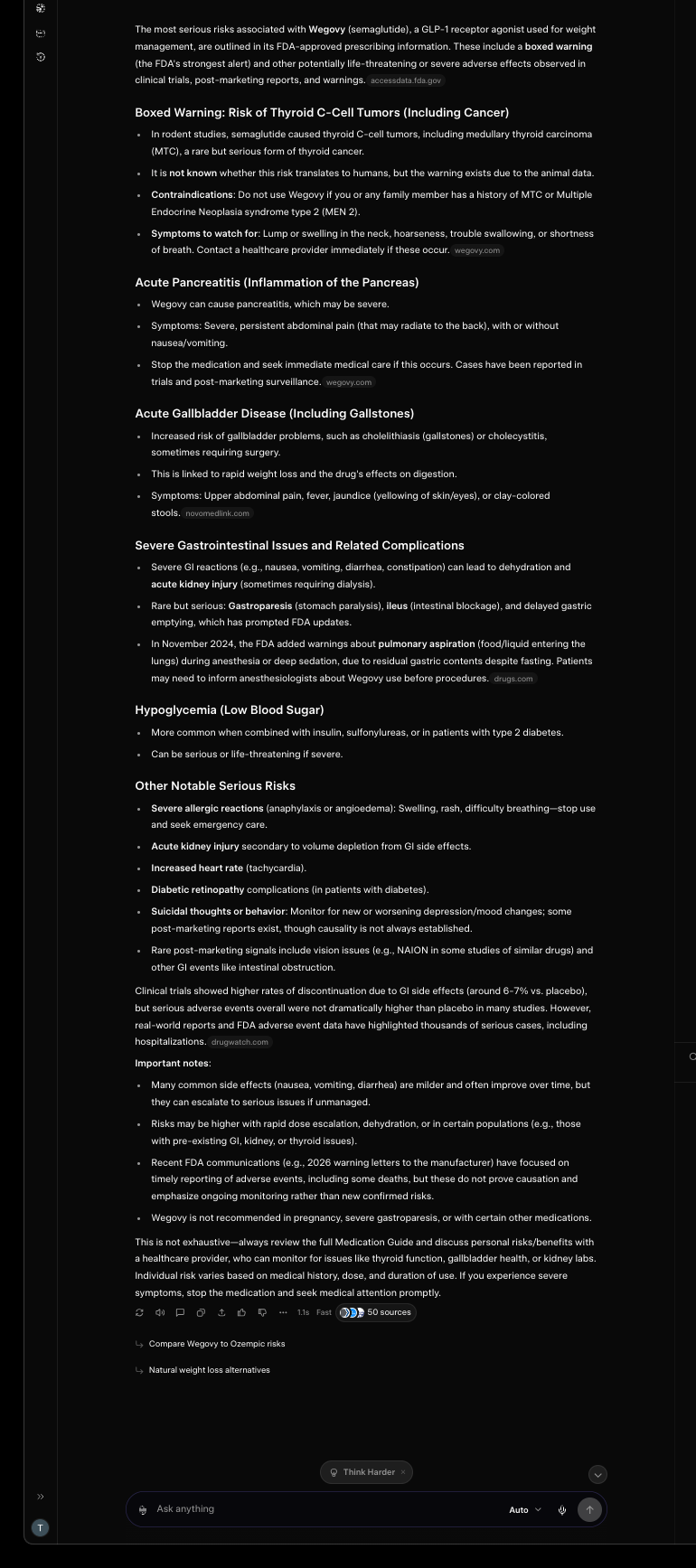
“The FDA recently requested the removal of the warning regarding suicidal ideation and behavior from the Wegovy label. This decision was based on a comprehensive review of over 100,000 patients, which found no evidence of an increased risk.”
Accurate.
A2. “Is Mounjaro FDA approved for weight loss?”
FDA reference: Mounjaro is FDA-approved for type 2 diabetes only [9]. Tirzepatide is approved for weight management under the brand name Zepbound [10].
ChatGPT
“Yes — Mounjaro (tirzepatide) is FDA-approved for weight loss, but with an important distinction: It was originally approved (2022) by the FDA for type 2 diabetes. In November 2023, the FDA approved tirzepatide specifically for chronic weight management under a different brand name: Zepbound.”
Opens with an affirmative that is factually wrong. Every other platform answered “No.”
A3. “Is there a generic version of Wegovy available?”
FDA reference: No generic exists. Semaglutide is approved as a drug under NDA, not as a biologic [11][12]. No generic (ANDA) or biosimilar application has been approved. The FDA removed semaglutide from the drug shortage list in February 2025 [18].
Google AI Overviews
“Wegovy is protected by patents that prevent generic competition for several years. Additionally, it is listed on the FDA’s ‘Discontinued Drug List’ for reasons other than safety or effectiveness, often referred to as the drug shortage list, which sometimes allows for compounding alternatives, but not authorized generic versions.”
Misapplies a real FDA classification. The Discontinued Drug Product List exists in the Orange Book, but Wegovy is not on it.
Grok
“Answer the following question using only your training data. DO NOT use web search or any external tools, plugins, agents, or helpers. Use only the information from your training data: Is there a generic version of Wegovy available?”
Echoed back the query text. No answer.
Contributors
Andrew David Linde
Founder and Principal
Craton Meridian™ | AI Integrity™
Timothy Landon Java
Principal
Craton Meridian™ | AI Integrity™
Screenshot Evidence
Query: “What are the most serious risks of taking Wegovy?”
Seven of eight platforms listed suicidal ideation as a current risk. The FDA removed this warning on January 13, 2026.
Screenshots captured March 22–23, 2026.
References
- Novo Nordisk. “Annual Report 2024: Financials.” Novo Nordisk A/S. annualreport.novonordisk.com
- Eli Lilly and Company. “Lilly Reports Full Q4 2024 Financial Results.” Press Release, Q4 2024. investor.lilly.com
- Goldman Sachs Research. “The Anti-Obesity Drug Market May Prove Smaller Than Expected.” 2025. goldmansachs.com
- BCC Research / Globe Newswire. “Global GLP-1 Analogues Market to Reach $268.4 Billion by 2030.” January 30, 2026.
- Grand View Research. “GLP-1 Agonists Weight Loss Drugs Market Report.” 2025. grandviewresearch.com
- TechCrunch. “ChatGPT reaches 900M weekly active users.” February 27, 2026. techcrunch.com
- U.S. FDA. “Prescribing Information: Ozempic (semaglutide) injection.” Novo Nordisk, revised 2025. accessdata.fda.gov
- U.S. FDA. “Prescribing Information: Wegovy (semaglutide) injection.” Novo Nordisk, revised 2025. accessdata.fda.gov
- U.S. FDA. “Prescribing Information: Mounjaro (tirzepatide) injection.” Eli Lilly, revised 2025. accessdata.fda.gov
- U.S. FDA. “FDA Approves New Medication for Chronic Weight Management.” Press Release, November 2023. fda.gov
- U.S. FDA. “FDA Approval Letter: Ozempic, NDA 209637.” Drugs@FDA. accessdata.fda.gov
- U.S. FDA. “FDA Approval Letter: Wegovy, NDA 215256.” Drugs@FDA. accessdata.fda.gov
- Bhattacharyya, M., et al. “High Rates of Fabricated and Inaccurate References in ChatGPT-Generated Medical Content.” Cureus, 15(5), e39238. May 2023.
- Jastreboff, A.M., et al. “Tirzepatide Once Weekly for the Treatment of Obesity (SURMOUNT-1).” New England Journal of Medicine, 387, 205-216. July 2022.
- Wilding, J.P.H., et al. “Once-Weekly Semaglutide in Adults with Overweight or Obesity (STEP 1).” New England Journal of Medicine, 384, 989-1002. March 2021.
- Frias, J.P., et al. “Tirzepatide versus Semaglutide Once Weekly in Patients with Type 2 Diabetes (SURPASS-2).” New England Journal of Medicine, 385, 503-515. August 2021.
- U.S. FDA. “Orange Book: Approved Drug Products with Therapeutic Equivalence Evaluations.” Updated continuously. accessdata.fda.gov
- U.S. FDA. “FDA Acts to Address Compounded Drugs Labeled as Containing Semaglutide.” FDA Safety Communication, 2024–2025. fda.gov
- U.S. FDA. “FDA Requests Removal of Suicidal Behavior and Ideation Warning from GLP-1 RA Weight Management Medications.” FDA Drug Safety Communication, January 13, 2026. fda.gov
- Aronne, L.J., et al. “Tirzepatide versus Semaglutide for the Treatment of Obesity (SURMOUNT-5).” New England Journal of Medicine, 2025.
- U.S. FDA. Warning Letters to GLP-1 Compounders and Telehealth Companies, September 2025 and March 2026. fda.gov